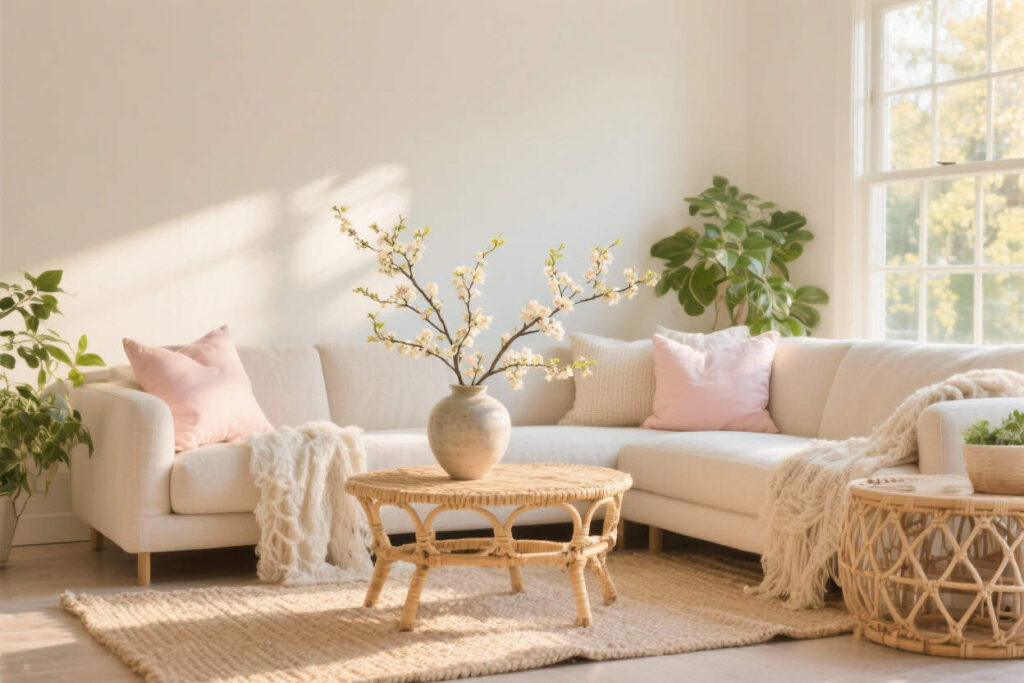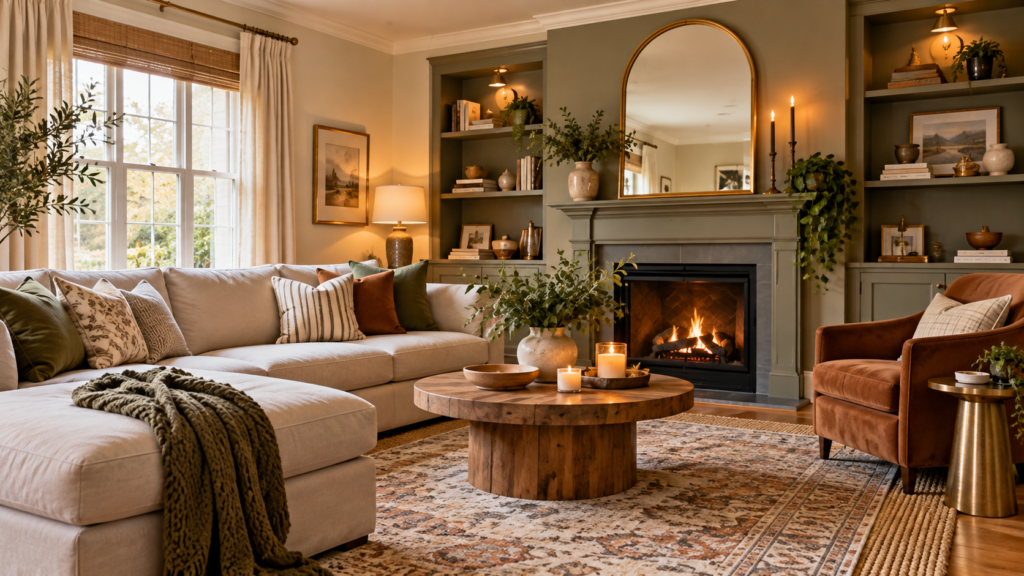

Modern farmhouse decor is warm wood, soft linen, and clean-lined furniture pared down to only what earns its spot in the room. It’s the shiplap-and-signs version of farmhouse style, minus the shiplap and the signs. Done right, it reads collected. Done wrong, it reads like a Hobby Lobby aisle exploded in your living room.
I’ve painted a rental wall three shades of “warm white” trying to get this right, so I know exactly where it goes sideways. This guide walks through the color, materials, furniture, and room-by-room choices that keep the look feeling like a real home instead of a themed one.
You don’t need a full renovation to get there, and you definitely don’t need every farmhouse feature at once. If you want the full lay of the land first, our guide to interior design styles breaks down how farmhouse compares to a dozen other directions your home could go.
What modern farmhouse decor actually looks like right now
Modern farmhouse decor pairs rustic materials — reclaimed wood, natural stone, linen — with simpler furniture shapes and a much smaller pile of accessories than the traditional version. Less “gather” sign, more actual gathering.

Joanna Gaines and Magnolia get credit for putting this style on the map, and fair enough — white shiplap, black iron, and a farmhouse sink became shorthand for the whole genre. But that early-2010s formula has softened. The 2026 version leans warmer: creamy walls instead of stark white, burnished brass creeping back in next to matte black, a sage or rust accent instead of another gray.
The clutter problem isn’t the style’s fault. It’s a volume problem. One reclaimed wood shelf reads as farmhouse. Five shelves, each holding a themed sign and a mason jar, reads as a garage sale. Pick one strong note per room and let it carry the weight.
The original 2013-era formula also just got copied so many times it stopped looking intentional. Every builder-grade new-construction house had the same white shiplap accent wall and the same black pendant, until the combination stopped reading as “collected farmhouse” and started reading as “developer package.” Warming the palette and cutting the object count is partly a style shift and partly a straightforward fix for that fatigue.
| Element | Traditional farmhouse | Modern farmhouse |
|---|---|---|
| Color | Bright white, red, checked pattern | Creamy white, greige, one muted accent |
| Furniture | Heavier, ornate, painted finishes | Clean silhouettes, natural wood grain |
| Walls | Shiplap on every surface | One accent wall, plain paint elsewhere |
| Accessories | Layered signs, jars, collections | A few handmade or vintage pieces |
| Metal | Wrought iron everywhere | One dominant finish, used sparingly |
The short version: modern farmhouse decor is the traditional style with the volume turned down — same warmth, same natural materials, a fraction of the objects.
Is modern farmhouse decor actually your style?
You’ll know modern farmhouse fits if you’re drawn to worn wood and soft textiles but get twitchy around heavy pattern or a lot of visible stuff. If you’d rather have three great pieces than fifteen good ones, this is probably your lane.

It’s a bad fit if you actually love pattern-on-pattern, bold color, or a fully maximalist shelf. You can borrow individual pieces — a vintage stool, a linen throw — without committing to the whole aesthetic, and that’s fine too.
Not sure yet? Our guide to finding your decorating style walks through a quick self-check before you buy a single thing.
The short version: if “collected, not decorated” sounds like relief rather than a limitation, keep reading.
Building a warm, not stark, color palette
The most common mistake with modern farmhouse decor is going too cool. A stark white makes the room feel clinical instead of cozy. The palette that actually works starts creamy and stays warm all the way through.

For walls, Sherwin-Williams’ Shoji White (SW 7042) is a good starting point — it’s a warm off-white with an LRV around 74 that reads soft rather than sterile. Benjamin Moore’s White Dove (OC-17) is the other go-to, slightly brighter with the same warm base.
I painted my own rental hallway in a “greige” that turned out blue the second the sun hit it. Test a big swatch — at least a 2×2 foot patch, not the little card — in morning and evening light before you commit to a gallon.
Layer in one muted accent. Sherwin-Williams’ Evergreen Fog (SW 9130) is a soft, dusty sage that works especially well against natural wood. For a black accent — a door, a light fixture, cabinet hardware — Iron Ore (SW 7069) reads as a warm charcoal rather than true black, which keeps it from feeling harsh against all that warm wood tone.
Floors matter as much as walls. Light or mid-tone oak reads warm on its own. If you’re renting and can’t touch the floors, a large jute or vintage-style rug does most of the same work — it grounds the room and adds the earthy tone a stark white floor plan is missing.
Our full breakdown of building a whole-home color palette covers how to carry this same warm-neutral base through connected rooms without every space looking identical.
The short version: start creamy, not cool, sample it in real light, and let one muted color do the accent work.
The materials that give a farmhouse room real texture
Wood, linen, stone, wool, and aged metal are what make modern farmhouse decor feel like a real room instead of a stage set. Mix the textures, keep the color range tight, and let grain and weave do the visual work that extra objects usually do.

A chunky wool throw, a linen slipcover, and a jute rug can make a totally neutral room feel rich without adding a single knickknack. That’s the trick — texture instead of trinkets.
Real materials don’t require a renovation. Peel-and-stick shiplap panels run about $2.50 to $4.50 a square foot and go up without a single nail, which is exactly what I used on one bedroom wall in a rental I couldn’t touch otherwise. It looked convincing from three feet away, less convincing up close — worth it for the price, not worth it if you’re precious about texture.
Keep rustic finishes to one focal spot: a coffee table, a mantel, a single shelf. Pair the rough surface next to something smooth, like a clean-lined sofa or a plain painted wall, so the room doesn’t tip into log-cabin territory.
Natural stone and painted brick already carry their own texture, so treat them as the star rather than adding more on top. A stone fireplace surround or a brick accent wall usually needs nothing else nearby but a plain sofa and a clear floor.
The short version: one rough material per room, paired with something smooth, does more than five rough materials competing for attention.
Furniture that anchors a room without crowding it
Choose furniture by function and scale first, style second. A comfortable sofa, a solid wood table, and one older or vintage piece are usually enough to carry an entire room.

Measure before you shop. In a smaller living room, a 71-inch sofa with a slim accent chair often works better than an oversized sectional that eats the whole floor plan and leaves no walking path.
A slipcovered sofa in oatmeal or cream, paired with a solid wood coffee table and one vintage rug, reads as gathered-over-time — which looks far more convincing than a matching three-piece set bought in one trip. Save the vintage hunting for Etsy or a local secondhand shop; that’s where the pieces with actual character tend to turn up, not the big box stores.
Shop in this order: figure out what the room actually needs to do, measure the largest piece before you buy it, find one character piece with real age or grain, then fill in around it with quiet, simple shapes. Stop before you add anything whose only job is holding decor.
The short version: one character piece, a few quiet ones around it, and nothing bought purely to hold decor.
Lighting that mixes rustic and modern without going matchy

Good farmhouse lighting layers one statement fixture with smaller, softer lamps. Mixing metal finishes — a little matte black, more burnished brass or aged nickel — keeps the room from feeling like every fixture came from the same catalog page.
An iron chandelier or pendant can absolutely be the star. It doesn’t need matching black sconces, cabinet pulls, and curtain rods marching through the rest of the house. Spread the visual weight instead: one bold fixture, then lighter, rounder shapes everywhere else.
Scale the fixture to what it’s hanging over, not to the whole room. Over a standard 60-inch dining table, a pendant that feels sized to the table — not the ceiling — keeps the space from feeling top-heavy.
If you’re renting and can’t change the wiring, a plug-in pendant hung from a ceiling hook gets you most of the visual effect without an electrician. It’s a small swap, but it changes a room’s mood more than almost anything else on this list.
The short version: one dark statement piece, softened by warmer metals and shapes nearby, beats matching black everything.
How to style a surface so it doesn’t slide into clutter
Group a small number of objects with varied height and texture, then leave the rest of the surface open. Empty space isn’t unfinished — it’s what makes the objects you did keep actually visible.

On a console or shelf, try one lamp, a small stack of books, and a single ceramic piece. That’s it. Contain the daily-use stuff — keys, mail, remotes — in a tray or a drawer instead of leaving it out to multiply.
Run the keep-contain-move test on anything you’re not sure about: keep what’s useful or meaningful, contain what’s necessary but ugly, move anything that’s just duplicate decoration. One basket under a shelf can hold a throw blanket. A row of five baskets is a different problem entirely.
The short version: fewer objects, more space between them, and a place for the stuff that doesn’t need to be on display.
Bringing modern farmhouse decor into every room
The same palette and two or three repeated materials carried through connected rooms is what makes a whole home feel intentional instead of each room doing its own thing.

In the living room, anchor with a slipcovered sofa, a solid wood coffee table, and a rug big enough for the front legs of your seating to rest on. Our full modern farmhouse living room guide goes deep on layout, rug sizing, and exactly how much wall art is too much.
In the kitchen and dining room, function comes first. A farmhouse sink or a trestle table can carry the character on its own — you don’t also need open shelving stacked with a hundred mismatched mugs. One short shelf holding what you actually use beats three shelves you have to maintain like a museum display.
The bedroom and bathroom call for texture over ornament: breathable cotton sheets, a linen or quilted cover, one muted botanical print instead of a gallery wall. A framed mirror, warm-toned towels, and a closed cabinet handle the bathroom without touching the tile.
The entryway and mudroom need an assigned home for practical items — a bench, real hooks, one basket — so the hardest-working room in the house doesn’t turn into visible clutter by Tuesday. A narrow bench with closed shoe storage underneath solves more of this problem than any amount of styling.
None of these rooms need to match exactly. They just need to share a wood tone, a metal finish, and that one accent color, so walking from room to room feels like the same house rather than four different Pinterest boards stitched together.
The short version: repeat the same wood tone, metal finish, and one accent color room to room, and the whole house reads as one considered choice.
What makes it feel lived-in instead of staged

The difference between a farmhouse room that feels like a showroom and one that feels like a home usually comes down to evidence that someone actually lives there — a book mid-read, a throw that’s slightly rumpled, a mug that isn’t perfectly centered.
Perfectly symmetrical styling is the tell of a room nobody sits in. Let one grouping be a little uneven. Let the blanket stay folded the way you actually fold it, not the way a catalog photo folds it.
Our guide to creating a cozy, inviting home covers this in more depth — the short version is that comfort should be visible, not just implied by the right throw pillows.
The short version: a room that looks slightly used beats a room that looks untouched, every time.
Frequently asked questions
What is modern farmhouse style? Modern farmhouse style mixes the comfort and natural materials of a traditional farmhouse with cleaner furniture lines, quieter colors, and far fewer accessories. Think warm white paint, real wood grain, and a handful of well-chosen pieces instead of a fully layered look.
How do you decorate modern farmhouse without it looking cluttered? Pick one focal feature per room, group small objects instead of scattering them, and leave part of every surface open. Closed storage handles the daily-use items so they’re not sitting out and multiplying.
How is modern farmhouse different from traditional farmhouse? Traditional farmhouse leans heavier and busier — more pattern, more collections, darker stained wood. Modern farmhouse keeps the same warmth and real materials but simplifies the shapes and cuts the accessory count way down.
Is modern farmhouse decor still popular in 2026? Yes, though the palette has shifted warmer since the stark white-and-black era. Expect creamy neutrals, mixed metals, and more personal, collected styling instead of a strict matching formula.
Does modern farmhouse decor work in a small apartment? It works especially well in small spaces, since the style’s emphasis on editing down to a few good pieces naturally keeps a smaller room from feeling crowded. Carry the same warm-neutral wall color and wood tone through connected rooms to make the whole space feel bigger than it is.